
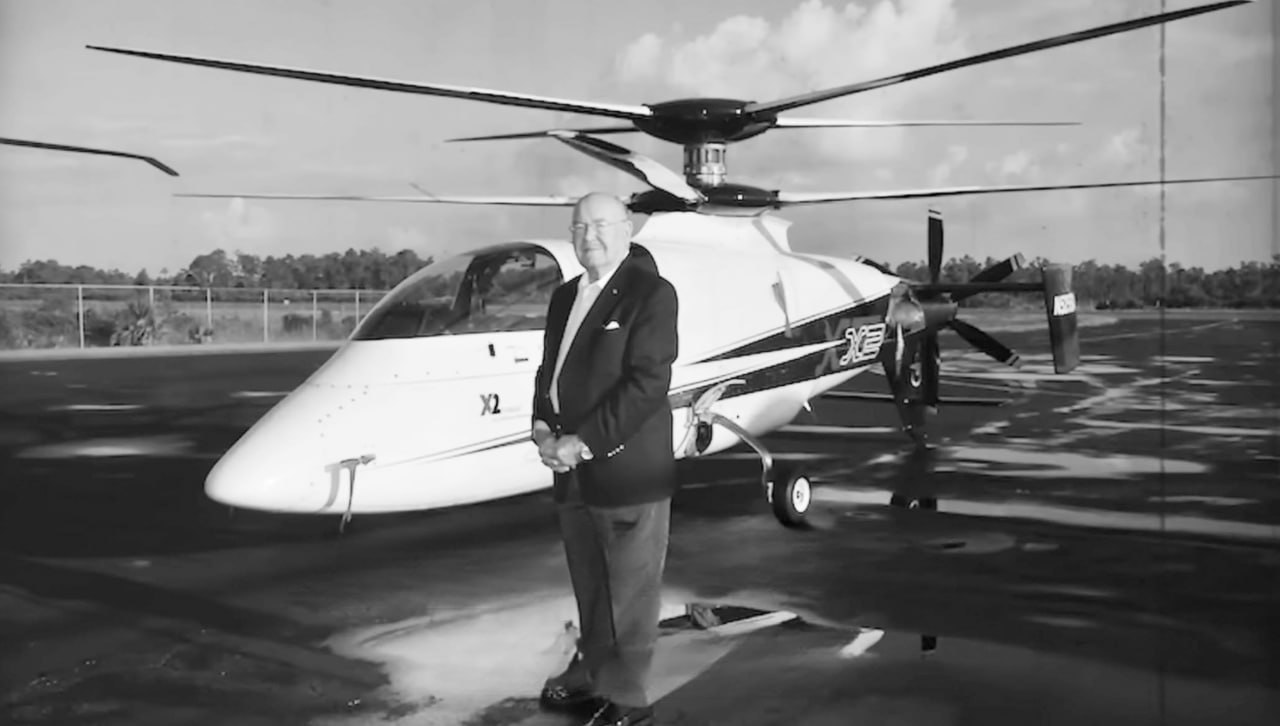
On September 18, the Sikorsky Aircraft company announced the sad news of the passing of one of Igor Sikorsky’s sons, Sergei Sikorsky. He lived to be exactly one hundred years old and made a significant contribution to the development of the American helicopter manufacturing industry. Because of his aeronautical achievements, name deserves to be remembered not only by people associated with American aviation but also by the new generations of Russian-Americans.
…I never had the chance to meet Sergei Igorevich personally, although I had plans to visit him in Arizona, where he lived. However, I was fortunate enough to speak with him once on the phone. On July 20 of last year, he called to congratulate his younger brother, Igor Igorevich Sikorsky, whom my wife and I were visiting. Of course, like many Russian-Americans, I had long been interested in the life of Sergei Igorevich.
Sergei was the eldest of Igor Sikorsky’s four sons. He was born in New York on January 31, 1925. In 1943, he graduated from the University School in Bridgeport. By this time, his father’s aviation company was already successfully developing here in Connecticut. The formation of American aviation unfolded before the eyes of the then-schoolboy. During these years, for example, Igor Sikorsky’s famous creations—the flying boats, large seaplanes that pioneered the first transoceanic routes—were being built. It was on one of these seaplanes – Sikorsky S-40, that Sergei Sikorsky, as an 8-year-old boy, took to the sky for the first time. This flight defined his future destiny.
In his final year of high school, Sergei switched to evening classes to work at his father’s factory during the day. There, under the guidance of the former Chief Engineer at the Sikorsky Aircraft, Eugene Gluhareff, the young man was already involved in the development of a new two-seater helicopter. This design work eventually led to one of Sikorsky’s most successful rotary-wing projects—the S-52 helicopter. A new modification of this machine, the S-59 turbine helicopter, set a world speed record of 156 miles per hour in 1954.
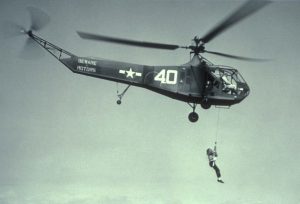
On a rescue hoist
After graduating, Sergei Sikorsky was drafted into the U.S. Coast Guard and served during the war in an experimental helicopter unit in Brooklyn, which was then commanded by Frank Erickson, one of the first helicopter pilots. At the time, rotary-wing aircraft were a new and very dangerous endeavor. They had just begun to be purchased by the U.S. War Department, and their potential for evacuating the wounded and rescuing those in distress was largely unexplored. In this situation, Sergei took on the role of, if you will, a “guinea pig”—a role that was far from safe.
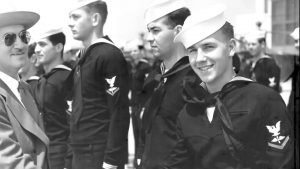
Frank J. Delear, author of one of the best and most complete biographies of Igor Sikorsky (Igor Sikorsky: His Three Careers in Aviation), quotes Sergei himself about his military youth:
“During those years, 1943 and 1944, I guess I spent more time on a rescue hoist than anyone else in military service.”
Russian author Nikolai Nadezhdin provides a telling anecdote in his book about Sikorsky:
“When the (R-4 helicopter) was equipped with a hoist, the test pilots flatly refused to sit in the rescue basket. Then Sikorsky himself demonstrated the advantages of the rescue device. He climbed into the basket, and the pilot Erickson lifted the machine above the heads of the pilots. The skeptics’ doubts were instantly dispelled. But Sikorsky did not stop there. To convince the military command of the safety of the rescue equipment, Igor Ivanovich recalled his son Sergei from the ‘Catalina’ seaplane on which he was serving and appointed him… a test subject for his hoists.”
Art, Languages, Astronomy and Archaeology
After World War II, Sergei Sikorsky worked briefly as a staff writer for the American Helicopter Magazine before enrolling in the School of Arts at the University of Florence (Italy), where he brilliantly graduated in 1951. As we can see, he was a man of great and diverse talents.
While at university, he became fascinated with linguistics. He would later speak fluently not only Russian and English, but also German, French, and Spanish, in addition to having a good command of Japanese. He also seriously pursued painting, classical music, astronomy, and underwater archaeology.
After his studies and travels through Europe and Japan, Sergei Sikorsky returned to his father’s company in Stratford. His education and erudition allowed him to represent American aviation with distinction in various fields. He participated numerous times in the prestigious Paris Air Show, where he met and communicated with Soviet designers, engineers, and test pilots, including the well-known inventor of the Soviet MI series of helicopters, Mikhail Mil.
According to contemporaries, Sergei even physically resembled his father, wearing a mustache from a young age and always being an attentive listener with a natural sense of humor. His passions—astronomy, music, archaeology—were also inherited from his father. Of Igor Ivanovich’s four sons, Sergei was the only one who also tied his life to the sky. He obtained American, German, and Swiss pilot licenses and logged over 800 hours flying various types of light aircraft. But his main contribution to aviation was the continuation of the family business in the world-renowned company founded by Sikorsky Sr.
Sergei I. Sikorsky Flight Center
During his distinguished 41-year career with Sikorsky, Sergei played a significant role in the company’s growth into one of the world’s leading helicopter manufacturers and the expansion of rotary aircraft around the world, states the official obituary from Sikorsky and Lockheed Martin.
In 2019, the aircraft hangar at the Sikorsky plant in Stratford was named the Sergei I. Sikorsky Flight Center. Sergei himself called this the “greatest honor of his life.”
“The entire team – past and present – at Sikorsky and Lockheed Martin mourn the passing of a remarkable man, a link to the golden age of aviation who meant so much to the success of our business,” said Rich Benton, Sikorsky vice president and general manager. “Sergei will be greatly missed.”
I will add that for us, Russian Americans, Sergei Igorevich Sikorsky will certainly be remembered as a man who, like his father and his entire family—his mother, sister, and brothers—carried the Russian name with great dignity here in the New World. It is difficult to imagine the Russian Heritage of 20th-century America without people like Sergei Igorevich Sikorsky, a World War II veteran, a fearless test specialist of new equipment, a pilot who loved the sky, an artist, a musician, and a businessman. May his memory be eternal!
Leave a Reply
You must be logged in to post a comment.