
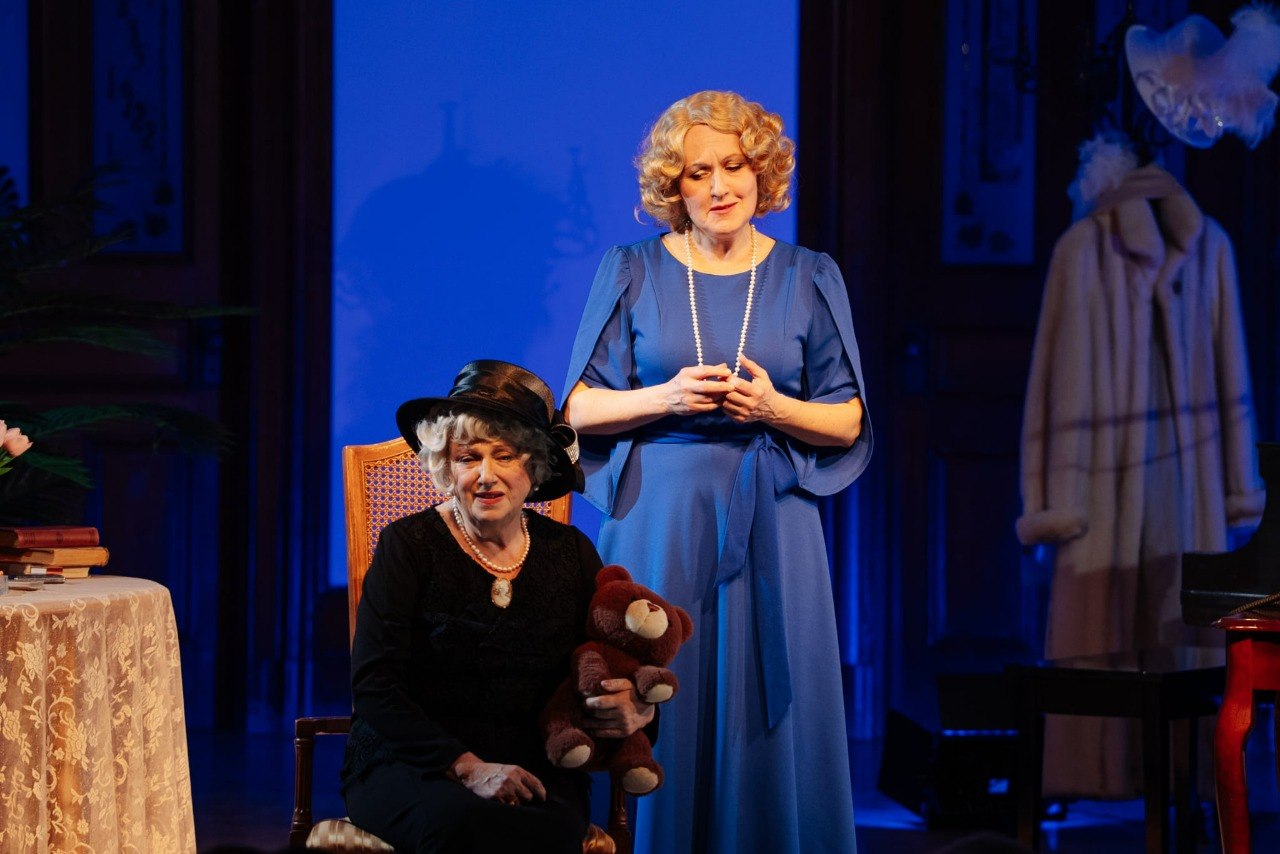
A play is currently running on the Montreal stage that is in no hurry. It is in no hurry to surprise, in no hurry to move you. It simply enters you—quietly, gradually—and stays for a very long time. Not everyone manages to see it; even after two performances, for many, it remains an unfulfilled dream. But brilliant productions, not just good ones, are never limited to only two shows, so—blessed is he who believes… and strives!
Faina Ranevskaya and Lyubov Orlova. Two names that have long since become symbols: one with a scathing, lethal wit that spread across the country faster than any newspaper; the other with a smile that seemed to brighten the sky above the movie theaters. We are used to encountering them only in their official, grand guise—on screen, in quote books, on postcards. This play offers something else: to strip away the ceremonial veneer and… step straight into their soul and heart. Not to offend, but to truly feel.
No monumental sets, no museum-like distance. Just a cozy, home-like setting. Two women, tired of the bright glare of the footlights. They reminisce about the roles they lived through, and the roles that never happened. They joke—sometimes bitterly, sometimes to the point of tears. And they share moments of silence—the kind of silence shared only with someone for whom words have long been unnecessary. It is in this silence that the play truly lives. Despite the abundance of dialogue, the most piercing and resonant element in it is the silence.
The history of the friendship between Ranevskaya and Orlova is paradoxical: Faina Georgievna: Ironic, sarcastic, and uncomfortably honest. Lyubov Petrovna: Radiant, impeccably composed, knowing exactly how to maintain her poise before the audience, the authorities, and her own doubts.
They were too different to become close. Yet, it was precisely this contrast that gave birth to what would later be called an “invisible friendship”—quiet and steady, like an underground river. For Orlova, Ranevskaya was the embodiment of the honesty she could not always allow herself. For Ranevskaya, Orlova was a person who accepted her unconditionally, without judgment, without barriers. Perhaps that was what she valued most in the world.
Anna Varpakhovskaya and Antonina Levina do not merely recreate their characters—they live them. Without copying, without parody, without treating physical resemblance as the end goal. They give the audience what is usually lost behind the brilliance of a legend: a living person—with all her complexity, tenderness, and unrehearsed humanity. Igor Chernis, who instantly transforms into a whole gallery of characters, brings that lightness and humor without which a conversation about friendship would be incomplete.
But there is another layer to this performance—quiet, almost invisible. And that is exactly what makes it special. Anna Varpakhovskaya’s theater is a dedication to her father. A man whose name is not engraved above the entrance but lives in his daughter’s heart. In a city where the winds of the Atlantic meet the echo of Russian melancholy (toska), this theater has become a living monument to the thread that connects children to their parents—woven from whispers, sacrifices, and inherited talent.
Lermontov and Blok dedicated poems to their mothers. Bach and Haydn—music. Nikolai Tsiskaridze—dances, Alexandra Zakharova—books and theater programs. Anna Varpakhovskaya dedicates the entire theater to her father. Every spotlight here is a spark of his gaze. Every pause on stage is a tribute to his memory. Every new performance is not a marble tombstone, but a living breath through which he continues to speak to the world through his daughter.
The audience sitting in the dim light of the hall feels this thread—it grows warmer, subtly connecting them to their own parents, to their own memories, to what is impossible to explain with words but impossible to forget. Not to admire, but to recognize! That is the mantle this play has wrapped around us. To recognize! In Ranevskaya—oneself, when hiding pain behind a joke. In Orlova—oneself, when smiling even though it is far from easy inside. In their friendship—that rare, almost vanished feeling: that there is a person beside you to whom nothing needs to be explained.
After the performance, you will want to rewatch the old films. Not as an archive of a bygone era, but as an encounter. With the two women you have just seen so up close, in their quiet, almost intimate world. And let there be laughter—genuine, not social. And let there be tears—quiet, not theatrical. And may everyone feel warm, for something alive and gentle will wash over the soul, refusing to let go for a long time. It is as if you have touched something soft—and it continues to warm you.
Some plays are merely watched. This one, you take with you.
In the photo (from right to left): Ambassador of Russian Romance in Canada and laureate of the “Maple Leaves” festival Antonina Levina (as Lyubov Orlova) and founder of the Russian Dramatic Theatre in Montreal, Honored Artist of Russia Anna Varpakhovskaya (as Faina Ranevskaya).
Leave a Reply
You must be logged in to post a comment.