
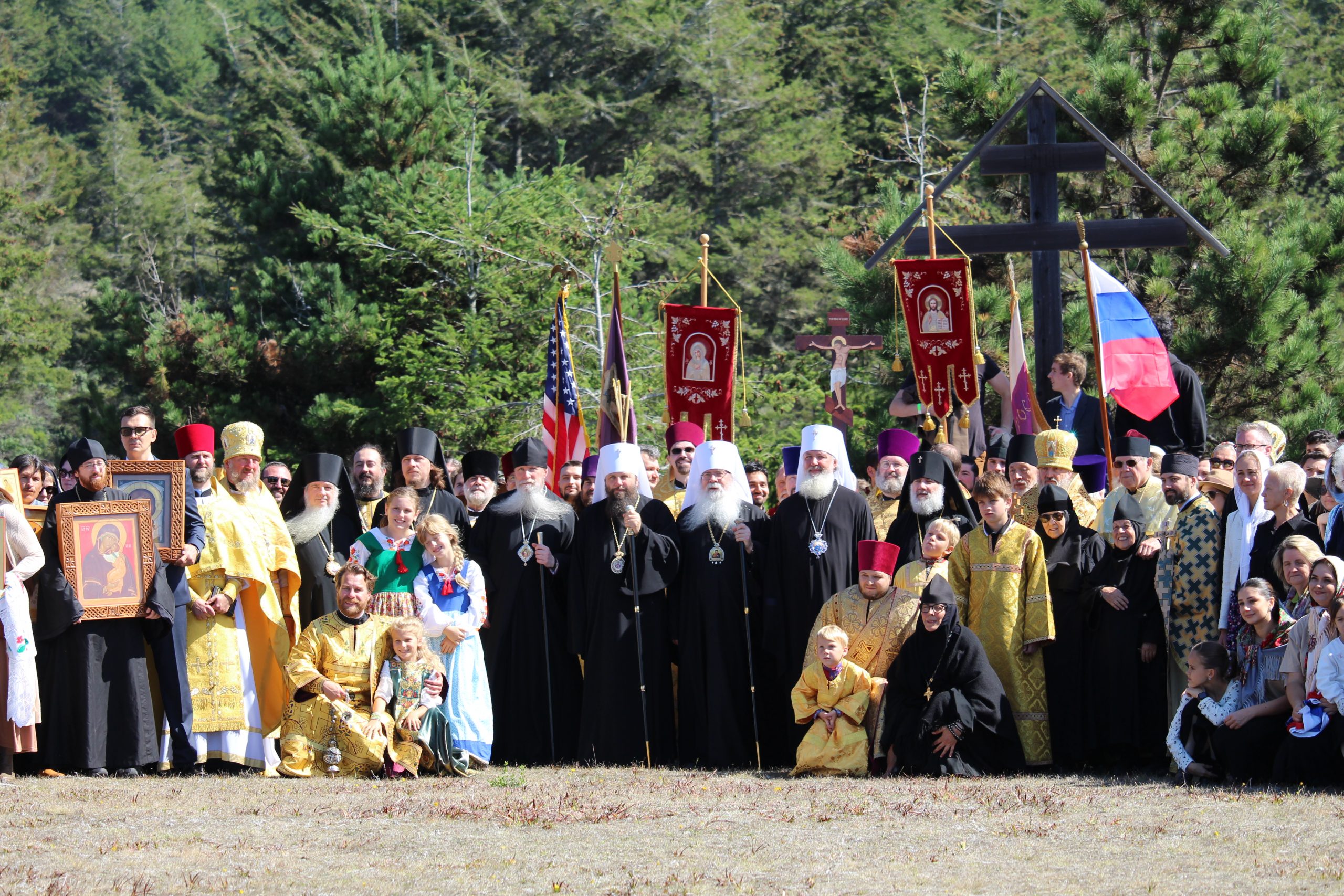
Hundreds of pilgrims flocked to Fort Ross in October to celebrate the Divine Liturgy and honor the Orthodox legacy in America. Attending the service at the oldest Orthodox parish in the continental US makes you contemplate and imagine the struggles that Russian missionaries and settlers faced in establishing an Orthodox presence in the New World.
The attendance of Metropolitan Maximillian of Irkutsk and Angarsk, together with Metropolitan Nicolas and Metropolitan Tikhon, made many revisit the deep cultural ties of Orthodoxy to Russia, and California’s rich connection to St. Innocent the Enlightener of Alaska, who came to Fort Ross on two occasions during the presence of the Russian American Company in California (1812-1841). Yet few realize that it was under his guidance that education at Fort Ross first took root and thrived, laying the foundation for a nearly 200-year-old tradition of Orthodox learning—one that every believer should cherish and defend, especially now, as such education faces uncertainty here in the heart of the Bay Area.
So when I hear some among the Orthodox faithful say that maintaining a fully accredited, English-language St. John of San Francisco Orthodox Academy is impossible due to financial strain and low enrollment, I can’t help but ask whether these challenges compare to the hardships faced by the 19th-century pioneers, who, despite far greater obstacles, built schools from nothing and ensured their children received an education rooted in faith and thirst for knowledge.
Fort Ross was built in 1812 and marked the southeastern border of the Russian Empire, stretching from North America, across Asia, and Europe. The commercial outpost brought many innovations to what is now Sonoma County, including farming, ranching, and healthcare. California’s first shipbuilding industry and the first windmill also flourished there. Standing on the frontier of the Spanish Empire and later Mexico, the Russian presence at the Settlement Ross was known, respected, and admired. Yet, in order not to antagonize their neighbors, the Russian American Company was very reluctant to allow the construction of the Chapel, which was built in 1824 against the Company’s wishes, and a school for the growing number of children at Fort Ross.
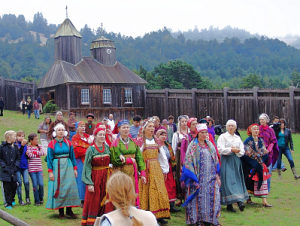
The Lancasterian, or monitorial, system of schooling, where older pupils taught younger ones under the supervision of a single instructor, was the dominant model of education adopted in the Russian-American colonies during the 19th century. At Fort Ross, an early attempt at educating children was made in 1818, but no stable school was established until 1837, a year after St. Innocent visited the fort. Before that, children from California were often sent to New Archangel (Sitka), where the Russian-American Company operated a school, maintained a sizable library, and supported an active Orthodox parish in which priests taught religious subjects. In 1834, Father Ivan Veniaminov assumed leadership of the school in New Archangel, and his lifelong dedication to education almost certainly influenced the eventual founding of a school at Fort Ross.
Educating youth in America was not an easy task. It required faith, dedication and perseverance. Fr. Ioann Veniaminov personified all of those virtues and much more.
Father Ivan Veniaminov’s achievements in education stand as a testament to both his vision and endurance in the harsh world of nineteenth-century Alaska. As head of the school in Unalaska for ten years (1824-1834), he not only built a school and organized instruction in reading, writing, arithmetic, and Orthodox faith but also led and encouraged the translation of religious texts into native languages, laying the groundwork for cross-cultural understanding. It is also important to remember that Fr. Ioann had his own family to take care of.

Father Ioann Veniaminov set out from Irkutsk as a volunteer missionary in early May 1823, accompanied by his elderly mother, his brother Stefan, his wife Catherine, and their infant son, Innocent. After a grueling year-long journey overland and by sea, the family finally reached Unalaska in late July 1824, where he immediately started his duties. Eventually, Fr. Ioan and his wife, Ekaterina Ivanovna, who was instrumental in running his schools, had 10 children together.
Unalaska, one of the largest islands in the Aleutian chain, became Father Ioann Veniaminov’s first mission field. The conditions he and his family encountered were extremely harsh: aside from an old wooden chapel, there were no proper buildings, and for a time, they had to reside in a traditional underground dwelling used by the Aleut people. Undeterred, Veniaminov immediately began planning a new church and a proper house. To make this possible, he instructed the local community in carpentry, masonry, and brick-laying, trades previously unfamiliar to them. By July 1825, the cornerstone of the Church of the Ascension was in place, much of the labor carried out by his own hands; alongside it, he constructed his family’s home and even crafted its furnishings himself. He also built clocks and organs. His thirst for knowledge and understanding led him to record systematic meteorological observations—temperature, storms, prevailing winds, and seasonal patterns, which he sent to the Academy of Science. These records provided some of the earliest documented climate notes from that part of Alaska and were valuable for both the Russian-American Company and later scholars.
His parish encompassed the entire Aleutian Islands and extended as far as the Pribilofs, forcing him each year to travel immense distances, often thousands of miles, by kayak, and at times with dog teams or on foot. The Aleutian climate, with its relentless fog, rain, and gales, made every journey a severe trial. Accounts tell of him arriving cold, soaked, and hungry, yet pressing on with unwavering resolve. Just imagine the reality for a man of towering stature, six feet three inches tall, cramped into the narrow frame of a native kayak, paddling across icy waters for hours, sometimes days at a time. Yet, through it all, Veniaminov pressed forward, carrying books and supplies along with his sermons, embodying the belief that knowledge and faith could transform even the most remote corners of the frontier.
“…Make every effort to establish and maintain an elementary school for the instruction of children in the Law of God, reading, and related subjects—after the manner of those that, by Imperial decree, are to be maintained … if it is not possible to organize a school according to these regulations, then at least once or twice a week gather the children of both sexes—first those of the resident Russians and Creoles, and later the newly converted—either at your home or in the chapel. Instruct them in their duties toward God, their parents, the authorities, one another, and their neighbors. To assist you in teaching the children to read and write, you may make use of your parish clerks,” Innocent of Alaska once instructed an Alaskan missionary Hieromonk Theophilus.
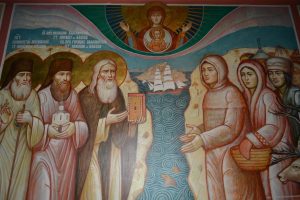
Once he gained fluency in the Aleut tongue, he immediately set about translating Scripture, beginning with the Gospel of Matthew. Recognizing that literacy was essential, he created an Aleut alphabet and opened a school where he personally taught reading and writing. Over the course of a decade among the Aleut people, his accomplishments were extraordinary: he rendered into their language not only Matthew but also sections of Luke, the Acts of the Apostles, the catechism, and large portions of the liturgy. His passion for language and science also led him to compile a grammar of the Aleutian-Fox dialect and to produce his celebrated ethnographic and natural studies, Notes on the Unalaska District, which described the region’s inhabitants, climate, and resources. In 1834, after ten years of this remarkable work in Unalaska, Veniaminov was reassigned to Sitka, the administrative and spiritual hub of Russian America.
By the time Father Ioann Veniaminov reached Sitka, the colonial capital already boasted an impressive library that became a cultural beacon for Russian America. Early donations came from Minister of Commerce and Russian American Company shareholder Nikolai Petrovich Rumiantsev, who sent 57 volumes on geography and exploration, followed by another 342 textbooks, maps, and atlases. The Imperial Academy of Sciences contributed 48 titles (219 copies), including Lomonosov’s Russian Grammar and Russian Chronicle, Krasheninnikov’s Description of Kamchatka, histories of Russia, Rome, and America, as well as works on medicine, mineralogy, and practical crafts. Governor Kirill Khlebnikov noted that by the early 1830s, the Novo-Arkhangelsk collection contained more than 1,200 titles: over 600 in Russian, nearly 300 in French, 130 in German, 35 in English, 30 in Latin, with others in Swedish, Dutch, Spanish, and Italian. Ferdinand Petrovich Wrangel, who governed the colonies between 1829 and 1835 and later became one of Russia’s most distinguished Arctic explorers and naval commanders, recorded that by the mid-1830s the library had expanded to 1,700 volumes, including about 400 Russian periodicals, together with an extensive set of maps and atlases. Regular shipments from St. Petersburg and Moscow ensured the shelves were stocked with the newest journals and scientific works.
Governor Ivan Kupriyanov and his wife, Yuliya Ivanovna, established a school for Native girls in Sitka and supported the extension of education across Russian colonies, including Fort Ross. During his 1836 journey to California, Fr. Ioann Veniaminov knew that well. His sailing to Fort Ross and his entire stay in California coincided with the arrival of Alexander Rotchev at the Russian commercial outpost. Rotchev and his charming wife, Elena Pavlovna Gagarina, were a highly educated and adventurous couple. He was an acclaimed poet and translator, and she, a representative of the highest Russian nobility with impeccable taste, exemplary manners, and a beautiful mind. The couple had been living in Sitka for over a year and knew Fr. Ioann Veniaminov well, not only as a preacher but as a Renaissance man. However, before the Rotchev couple and their children were deployed to California in 1837, Rotchev made a scouting trip to California on the same ship that Fr. Ioann sailed to reach the Ross counter. The two men walked the same shores, breathing in the fresh air and envisioning a future for the fort.
When A. Rotchev was deployed with his family to Fort Ross, the governor instructed him, among numerous other tasks, to take care of the orphans and kids. With Kupriyanov’s backing, a small school was established – something between a kindergarten and a primary academy, intended to guide pupils in their first steps of learning. To aid their instruction in reading and writing, he ordered an urgent shipment of books and school supplies from New Archangel. Mikhail Ivanovich Kamensky, a prikazchik of the store, was placed in charge of the school. A Native of St. Petersburg, he was 47 years old at the time of Fr. Ioann’s 1836 visit. He was single and an experienced frontierman.
Rotchev’s wife, the lovely Elena Gagarina, a highly educated lady, undoubtedly also taught the girls at the settlement, teaching them how to play the piano, California’s first, and teaching them about the local ecology. When she returned to Russia, she was appointed to run the Girls’ Institute in Irkutsk, where in 1852 she completed and published a two-volume translation of Julie Ulliac-Trémadeure titled “Little Naturalists or Family Conversations about Animals, Plants and Minerals.” Madame Ulliac-Trémadeure was a French author known for her didactic and moral works for children and young women.
And so in 1837, education was established by the Russian American company at Fort Ross, a proud tradition that expanded over the 20th century, reaching a pivotal moment a history with the establishment of the St. John of San Francisco Orthodox Academy in 1994.
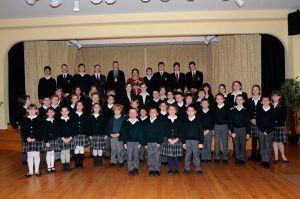
Nearly two centuries separate the school at Fort Ross and the classrooms of St. John of San Francisco Orthodox Academy, yet they are bound by the same unbroken spirit: the conviction that faith and knowledge are inseparable. What began on the rugged shores of California under the blessing of St. Innocent endures today in the heart of the Bay Area, where teachers and students continue the sacred task of learning in the light of Orthodoxy. To sustain St. John Academy is to honor that lineage—to ensure that the voice of Orthodox education, first heard at Fort Ross in 1837, still echoes in our time and for generations to come.
Leave a Reply
You must be logged in to post a comment.