
In the first years after the end of the Cold War, Russian-American relations experienced an extraordinary upsurge: cultural and student exchanges became more frequent, American economic advisers, financiers, journalists and politicians became frequent guests in Russia, and the “fourth” post-perestroika wave of emigration from Russia to the United States began. Air traffic and visa departments of the missions of the two countries have been expanded to accommodate these flows of people. To many people, it seemed that an infinite era of peace, friendship and cooperation had arrived.
The First Clouds on the Horizon
The first clouds in the clear skis of Russian-American relations appeared in 1996 due to the intention of the NATO military alliance to accept Poland, the Czech Republic and Hungary into its ranks which did happen in 1999. In August 1998, the pyramid of Government Credit Obligations (GCO) collapsed in Russia and a bank and sovereign default followed. Well-founded doubts took hold about the correctness of the economic course taken by Russia on the advice of American experts in the field of finance and economics. In September 1998 the liberal government of Sergei Kiriyenko was replaced by the conservative government of Yevgeny Primakov which relied on Soviet experience and management methods and was ready to take harsh administrative measures to remedy the situation. A low and somewhat turning point was the episode which occurred on March 24, 1999, when the plane of Russian Prime Minister Yevgeny Primakov, who had gone to Washington for talks, turned around over the Atlantic and returned to Moscow because of the launch of the NATO operation against Yugoslavia [1].
Unfortunately, since then, the relations between the two countries have been gradually deteriorating for more than a quarter of a century. A brief warming took place after the terrorist attacks in the United States on September 11, 2001, when Russian President Vladimir Putin was one of the first world leaders to express condolences to U.S. President George W. Bush and offered his administration assistance in combating international terrorism [2]. Parts of the ruling American elite even began to consider Russia’s second war in Chechnya at that time as part of a global war on Islamic terrorism, which was what V. Putin sought from the very beginning of that war. However, just a year and a half later, the war against Iraq which was being prepared by the Bush administration in 2002 and early 2003 again divided the two countries: Russia categorically opposed it [2].
On the Brink of Direct Confrontation
The intention to admit the former Soviet republics of Georgia and Ukraine into NATO expressed by G. W. Bush in the summer of 2008 further worsened Russian-American relations. The Russian operation to force Georgia to peace terms in August 2008 brought Russia and the United States close to the brink of direct armed conflict, as an influential group in the American administration headed by then US Vice President Dick Cheney was extremely belligerent and lobbied for attacks on the Roki tunnel which Russian troops used to enter the territory of South Ossetia [3].
The Obama administration, despite its initially peaceful rhetoric and the Nobel Peace Prize awarded to Obama as an advance, began a rather aggressive foreign policy from its very first term aimed, among other things, at squeezing Russia out of its remaining traditional spheres of influence. In particular, the Obama administration rode the “Arab Spring”, as the wave of color revolutions that swept through a number of Arab countries was called, which began in the first months of 2011 and which had as its goal overthrowing secular nationalist regimes and replacing them with Islamist ones [4].
In the spring and summer of 2011 the “Arab Spring” swept away the regime of Muammar Gaddafi in Libya, which was friendly to Russia. It was only with significant material and direct military support to the government of Bashar al-Assad in Syria that Russia managed to put the Arab Spring on hold for a long time. After the outbreak of the insurgency and civil war in Syria in 2011-2012, the relations between Russia and the United States continued to deteriorate. Due to the failure of the color revolution in Syria, the US administration in fact led a campaign to accuse the Syrian leadership of using chemical weapons against the rebels and civilians and to prepare direct Western military intervention in Syria under this pretext. This step would clearly lead to a clash with the Russian expeditionary force in Syria, and the rhetoric of the Obama administration and especially the US State Department led by Hillary Clinton has become so anti-Russian and militaristic that Russian President Vladimir Putin ordered large-scale exercises involving about 160,000 Russian troops in the summer of 2013. This was clearly intended to serve as a signal for the Obama administration to reduce its militaristic fervor [5].
The Worst Period in Relations?
It is widely believed in the United States that the reason for the onset of the worst period in Russian-American relations in almost the last hundred years was Russia’s support for separatists in eastern Ukraine in early 2014, and especially Russia’s direct military intervention in the Ukrainian conflict in February 2022. However, we would like to remind our readers that the unprecedented decision by the Western heads of state and government not to attend the opening and closing ceremonies of the Winter Olympic Games in Sochi in February 2014 was made when Viktor Yanukovych was still President of Ukraine, which is before the prerequisites for separatism in eastern Ukraine and its support by Russia had developed [6].
Relations between Russia and the United States quickly fell into the abyss in early 2022 due Russia’s direct intervention in the civil war in Ukraine. The following years were marked by the imposition of literally thousands of sanctions on Russia, closure of the dollar financial system for it, cancellation of flights, reduction of diplomatic missions and attempts to abolish Russian culture in the United States. According to some experts, relations have dropped to a level unprecedented even during the Cold War [7]. This state of relations between the two largest nuclear powers carries high risks for the whole world. There are political forces in both countries that are aware of this and are striving to move relations from an absolute minimum in their entire history. The summit of Presidents Trump and Putin in Anchorage in August 2025 showed great hopes for reaching an agreement between Russia and the United States and reducing the degree of tension, but, unfortunately, it did not justify the hopes placed on it. Since the executive branch has shown its limitations in establishing better relations, the legislators of both countries have stepped in. The idea of establishing contacts with Russian parliamentarians and inviting them to visit Washington to meet with American lawmakers was born in the depths of the House of Representatives of the US Congress.
The First Step. What’s Next?
The initiative to organize the visit of the Russian State Duma delegation to the United States had to come from a member of Congress or a group of congressmen. It is probably no coincidence that Anna Paulina Luna, a member of Congress from the Republican Party from Florida, was chosen to announce the idea of resuming inter-parliamentary contacts. Firstly, she is an ardent supporter of US President Trump, and she, in particular, supported his repeatedly stated intentions to negotiate with Russia on acute issues of bilateral relations. Her public support for such a course is evidenced by her meeting with the special representative of the President of Russia Kirill Dmitriev during his visit to the United States in October 2025 [8]. Secondly, Congresswoman Luna is a veteran of the US Air Force, and this makes it more difficult to accuse her of an “unpatriotic stance.” Thirdly, in the November 2024 congressional elections, Anna Paulina Luna was re-elected to Congress in her district with 55% of the vote. Such an advantage makes it unlikely that the campaign to discredit her as an “agent of Russian influence” in her district will succeed and minimizes the risk that she will not be able to be re-elected due to such accusations in the next congressional elections in November 2026.
The five Russian State Duma deputies invited by the congresswoman are under US sanctions for their alleged involvement in or support for the outbreak of a full-scale war in Ukraine. In order for the deputies to obtain American visas and travel to the United States, it was necessary to at least temporarily lift the sanctions on them. This is within the competence of the US State Department whose lifting of sanctions indicates that the Trump administration supports the contacts between parliamentarians. The five–member Russian delegation included representatives from all four parliamentary factions of the State Duma – United Russia, the Communist Party of the Russian Federation (KPRF), Fair Russia and the Liberal Democratic Party of Russia (LDPR). The delegation was led by Vyacheslav Nikonov, Deputy Chairman of the State Duma Committee on International Affairs. According to the Free Russia Foundation, the appointment of V. Nikonov as the head of the delegation signifies that the delegation has formal authority to negotiate with American congressmen and not just make an informal introductory visit [9].
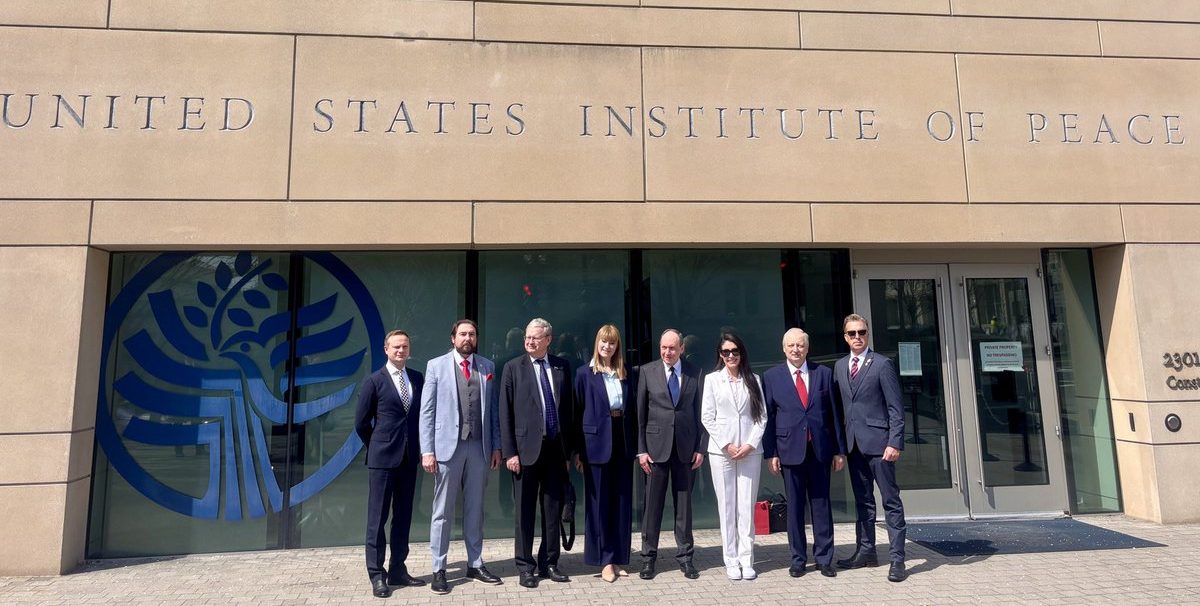
This is supported not only by V. Nikonov’s high position, but also by his fame and weight in Russia as a specialist in international affairs, and moreover a hereditary one: Nikonov is the grandson of Vyacheslav Molotov, People’s Commissar (Minister) of Foreign Affairs of the USSR in 1939-1946 and again in 1953-1956. It is also noteworthy that the delegation included Mikhail Delyagin, a deputy from the Fair Russia party and a well-known economist in Russia, who harshly criticizes liberal methods of economic management and the liberal economic paradigm in general. The Russian Duma delegation arrived in Washington on March 25, and visited the Capitol the next day where they met and negotiated with five American congressmen.
In addition to Anna Pulina Luna, they included three conservative Republicans – Derrick Van Orden (Wisconsin), Andy Ogles (Tennessee), Eli Crane (Arizona) and one Democrat, Vicente Gonzalez (Texas). According to Congresswoman Luna, after the meeting with the State Duma delegation, the main subject of negotiations was finding ways to end the armed conflict in Ukraine. The visit of the delegation of the Russian State Duma to the United States is undoubtedly a positive step towards improving relations between the two countries which are in a state of the deepest protracted crisis. Having such a responsible and courageous representative in the US Congress as Anna Paulina Luna gives hope that contacts between lawmakers will continue and that they will help overcome the crisis in US – Russia relations.
PHOTO: A meeting of U.S. and Russian lawmakers in Washington. March 26, 2026. Source: Twitter account of Congresswoman Anna Paulina Luna.
- Paddock, Richard C. “Primakov Does U-Turn Over Atlantic, Heads Home” // LA Times – 24 March 1999 https://www.latimes.com/archives/la-xpm-1999-mar-24-mn-20482-story.html (retrieval date: 30 April 2026).
- Hill, Fiona “Putin and Bush in Common Cause? Russia’s View of the Terrorist Threat After September 11” // Brookings – 1 June 2002 https://www.brookings.edu/articles/putin-and-bush-in-common-cause-russias-view-of-the-terrorist-threat-after-september-11/ (retrieval date: 30 April 2026).
- Smith, Ben “U.S. pondered military use in Georgia” // Politico – 3 February 2010 https://www.politico.com/story/2010/02/us-pondered-military-use-in-georgia-032487 (retrieval date: 30 April 2026).
- “Obama Sees Arab Spring as Moment of Opportunity” // NPR – 19 May 2011 https://www.npr.org/2011/05/19/136468135/obama-sees-arab-spring-as-moment-of-opportunity (retrieval date: 30 April 2026).
- “Massive Military Drill Underway in Russia’s Far East” // Radio Free Europe/ Radio Liberty – 14 July 2013 https://www.rferl.org/a/russia-massive-military-drill/25045676.html https://www.rferl.org/a/russia-massive-military-drill/25045676.html (retrieval date: 30 April 2026).
- LaFranchi, Howard “Western leaders stay away from Sochi Olympics. Snub to Russia?” // Christian Science Monitor – 10 February 2014 https://www.csmonitor.com/World/olympics/2014/0207/Western-leaders-stay-away-from-Sochi-Olympics.-Snub-to-Russia (retrieval date: 30 April 2026).
- Logan, Justin “Relations with Russia. 2022 CATO Handbook for Policymakers” // CATO Institute https://www.cato.org/cato-handbook-policymakers/cato-handbook-policymakers-9th-edition-2022/relations-russia (retrieval date: 30 April 2026).
- Chance, Mathew “Top Russian envoy visits US for ‘official’ talks, days after Trump imposes sanctions on Moscow” // CNN – 25 October 2025 https://www.cnn.com/2025/10/24/europe/kirill-dmitriev-russian-envoy-visits-us-intl (retrieval date: 30 April 2026).
- Kelly, Laura “Luna hosts Russian lawmakers to mixed GOP reactions, outrage from others” // The Hill – 26 March 2026 https://thehill.com/policy/international/5803437-luna-russian-delegation-meeting/ (retrieval date: 30 April 2026).
Leave a Reply
You must be logged in to post a comment.