
In October 2025, the House of the Russian Abroad (HRA) celebrated the 30th anniversary of its founding. I, as the HRA representative in the United States, also took part in this event. To mark the difficult journey leading to this milestone, the House’s film studio Russian Path produced a film entitled In the Name of Memory and Truth, which was shown during the Jubilee celebrations on October 27–28. The same studio, under the direction of Sergei Zaitsev, created a unique film from rare pre-revolutionary archival film footage. The film is dedicated to that great historical Russia for which those who retreated fought, hoping to return, carrying it with them and preserving it in exile. The film also tells of the tragedy of the Civil War, which marks the beginning of the epic of the Russian Abroad.
Gala Program and Guests
The Jubilee program at the House of the Russian Abroad began on October 27 with a traditional tea. Donors and friends who had come from abroad assembled around a long table with samovars and abundant refreshments. Several participants once again made donations of their family heirlooms, while others contributed valuable historical materials. Guests were welcomed by the Director of the House of the Russian Abroad, Viktor Aleksandrovich Moskvin, and Deputy Director Igor Vladimirovich Domnin.
At the beginning of the solemn gathering in the beautiful cinema-concert hall of the Museum, guests and staff were shown a film about the creation and development of the House of the Russian Abroad, highlighting the role of Aleksandr Isaevich Solzhenitsyn, the Moscow city government, the director and deputy director of the House, as well as foreign collaborators such as co-founder and first donor N. A. Struve (France), L. S. Obolensky (USA), and many others. It was a pleasure to see a photograph of my father, Rostislav Vladimirovich Polchaninoff, one of the greatest donors to the House, together with me and my son George.
The Only Museum of the Russian Abroad
The dramatic finale of the film presented a vivid picture of the grand construction of the Museum. As Viktor Aleksandrovich Moskvin noted, for the more than 30 million people of the near and far Russian Abroad, there now exists only one single state professional museum. Plans were discussed for creating a branch gallery to house the many valuable paintings and other forms of émigré visual art that have accumulated in the Museum’s collections.
After the film, congratulations were offered to the leadership and staff of the House from governmental and public organizations, followed by the awards being given to distinguished employees. Among those honored was director Sergey Zaitsev. In tribute to his film They Died for France, the House’s bard Viktor Leonidov performed a moving song about the heroes of the Russian Expeditionary Corps, who saved France during the First World War.
It should be noted that only Serbia gave refuge to Russian veteran-allies and provided assistance to disabled soldiers on equal terms with its own military. France and the other “allies,” however, abandoned them to their fate. The program concluded with Honored Artist of Russia Andrey Mezhulis, who presented poems and songs on the theme of Vertinsky for All Time.
Returning Memory
On the following day, the Jubilee program began with the opening of the exhibition called “I Will Return as a Reflection — From Russia to Russia”, created with the support of the Heritage Fund of the Russian Abroad and the State Corporation VEB RF. Prince Dmitry Mikhailovich Shakhovskoy (France–Russia) spoke about the great role that the House and Museum of the Russian Abroad play in preserving Russia’s historical heritage, especially since in the Abroad itself the number of those who remember it decreases with each generation.
I added that at the same time, such people as he, including some of my own acquaintances, have “returned” to Russia. We already have the fifth generation of descendants of the White Emigration who remain faithful to their heritage, and the opportunity to travel to the Land of their forebears and to visit such a Museum, our Home in Russia, strengthens this bond.
In separate interviews I spoke about how we collect valuable materials to send to the House in containers from people such as V. Nabokov and I. Sikorsky, and I showed journalists the exhibits we had recently brought for the exhibition:
- Works of the well-known sculptor V. G. Deryuzhinsky — portraits of composer A. T. Grechaninov and pianist A. I. Ziloti, donated by N. M. Kluge, granddaughter of an officer of a sector of the General Staff, who served in the Russian army and Navy in Shanghai.
Reporters also filmed me with my son in a room filled with hundreds of boxes, where we were sorting through the vast archives of my father, recently delivered by container.
On International Humanitarian Partnership
The culmination of the celebration was the solemn gathering in the main hall of the Museum. At the gathering, His Eminence, Methodius, Bishop of Yegoryevsk, Vicar of Patriarch Kirill of Moscow and All Russia, read the greeting of His Holiness: “I joyfully recall the day in 1995 when I took part in the opening of the House of the Russian Abroad. In the time since then, much has been accomplished so that the rich heritage of the Russian emigration has become known in contemporary Russian society and has taken its rightful place in the treasury of national culture.”
The greeting of the President of Russia, V. V. Putin, was read by his plenipotentiary representative I. O. Shchyogolev. In it, the President noted that the House “over these years has grown into a scientific, educational, and cultural center of nationwide scale… It is important that within the walls of the House extensive exhibition and publishing activities are being carried out, a film studio is operaings, and multifaceted research projects are implemented to study the creative heritage of the Russian Abroad. All of this helps to strengthen friendly contacts with compatriots on all continents, to promote the traditional values of Russian society, the Russian language and literature, and, of course, contributes to the development of international humanitarian partnership.”
The Minister of Foreign Affairs of the Russian Federation, S. V. Lavrov, who is Chairman of the House’s Board of Trustees, in his message to the House and its leadership noted: “Your scientific, research, and educational platform provides everyone with the opportunity to become acquainted with the Chronicle of the Russian Abroad, to become closer to the richest spiritual heritage of Russian people who, by forces of fate, found themselves in foreign lands…” In light of this, awards of the Ministry of Foreign Affairs of the Russian Federation were presented to the Director of the House, V. A. Moskvin, Deputy Director for Cultural-Historical Heritage I. V. Domnin, and Director of the film studio Russian Path S. L. Zaitsev.
“…A miracle is not sent to those who do not labor toward it.”
Participants of the Jubilee included honored guests, benefactors, and friends of the House of the Russian Abroad and its Museum from abroad, among them Prince Dmitry Mikhailovich Shakhovskoy, the head of the Union of Nobility in France, Count Sergey Alekseyevich Kapnist, as well as Mikhail Drozdov, Chairman of the World Coordinating Council of Russian Compatriots Living Abroad (WCC). Also present were parliamentarians, heads of public and cultural organizations such as Deputy Speaker of the Federation Council Konstantin Kosachev, representatives of the Moscow government and the Ministry of Foreign Affairs, Chairman of the Imperial Orthodox Palestine Society and former Prime Minister of Russia Sergey Stepashin, Special Representative of the President of the Russian Federation for International Cultural Cooperation Mikhail Shvydkoy, Ambassador Extraordinary and Plenipotentiary and President of the Russian Abroad Heritage Foundation Alexander Avdeev, and head of the Russian Charitable Foundation of Alexander Solzhenitsyn, Natalia Dmitrievna Solzhenitsyna.
Since some remarked that the creation of the House and Museum dedicated to the Russian Abroad seemed like a miracle, Natalia Dmitrievna in her speech quoted from A. I. Solzhenitsyn’s novel August 1914: “But, as tradition tells, a miracle is not sent to those who do not labor toward it.”
Dmitry Mikhailovich Shakhovskoy, in his speech, spoke about the tragedy and atrocities of the Jacobins in the Vendée during the French Revolution, which the Bolsheviks adopted as an example for their Red Terror. A. Solzhenitsyn was invited to the Vendée in 1993, on the bicentennial of the French tragedy. At the unveiling of the monument to the victims, he said: “Russian people who lived through the Civil War saw several such Vendées in our country. For me, these are my own brothers.”
“A people who do not know their past have no future.”
I dedicated my speech to the main essence of the Russian Abroad, its historical mission, and the immense significance of the House of the Russian Abroad for the future of Russia — the future for which those who retreated abroad fought, hoping to return, as did my family. I began with the words of the great Lomonosov, who said: “A people who do not know their past have no future,” and with a quote from the writer George Orwell: “Who controls the past controls the future…”
It is precisely in the House and Museum of the Russian Abroad that modern Russia can learn the unaltered historical truth about its great Motherland, thanks to materials preserved by generations of Russians abroad. While the Bolshevik internationalists portrayed Russia as a backward, aggressive country for centuries — a “prison of peoples” they claimed to have “liberated” — the various peoples of Russia fought together for a United, Indivisible Great Russia and its traditional values.
In the White Army, in the Armed Forces of South Russia (AFSR), there were warriors of the former Caucasian “Wild Division,” Kalmyks, and other peoples of Russia — and the majority were natives of the territory of present-day Ukraine. They all retreated together from Crimea in 1920. Unfortunately, the imposed Russophobic myth of the “prison of peoples” still lives on in the former republics of the USSR. The House and Museum of the Russian Abroad fulfill the central mission of generations of Russians abroad — to bear witness to the truth of historical Russia, which continued to live outside the homeland for more than a century, for the sake of its future.
The materials of the Russian Abroad confirm that on the eve of the First World War, Russia was an advanced industrial country. Mendeleev predicted its population would reach 594 million by the mid-20th century. They also show that before the Bolshevik coup and their signing of the shameful Treaty of Brest-Litovsk, Russia and America were friends and allies.
My son, George, who represents the fourth generation abroad, spoke about how he was raised both at home and in parish school, and in the Organization of Russian Young Scouts (ОРЮР) in the spirit of “Facing Russia.” He traveled with me from the age of 14 to Russia, reviving scouting in its homeland. Now he continues the work of his grandfather, working with his archives, which contain not only historical materials, but also much that is useful for new generations of a resurrecting Russia.
On the Bard of White Russia, Artist Dmitry Belyukin
At the festive reception after the program, I met many acquaintances, including N. G. Sabelnik, President of the Congress of Russian Americans, and the renown Russian artist Dmitry Belyukin, author of the famous painting “White Russia. Exodus,” which often adorns the walls of our organizations in the Russian Abroad.
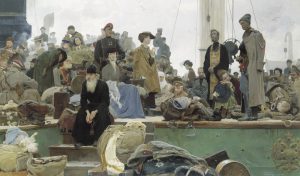
In 2022, the Exhibition Hall of the House of the Russian Abroad hosted the opening of “White Russia. Exodus. The History of One Painting,” where sketches, studies, drafts, and examples of the immense painstaking labor that went into creating such a painting were presented. The original is housed in the Civil War Hall of the Central Museum of the Armed Forces of Russia, while a reproduction decorates the main entrance of the House of the Russian Abroad.
I met Dmitry in 1991 and visited his studio when the young artist began painting this epic canvas. I saw the historical objects that later appeared on the master’s canvas… Since then, the artist has developed the theme of the White Movement, including Lemnos, Gallipoli, and Bizerte, in paintings such as “Landing of General Kutepov’s Corps in Gallipoli,” “The Famous Tent of the Drozdovsky Rifle Regiment in Gallipoli,” and “A Foreign Dawn. Cossacks on the Island of Lemnos.” This is especially close to me, since my family and my husband’s family retreated with General Wrangel, when “We left Crimea amidst smoke and fire…”
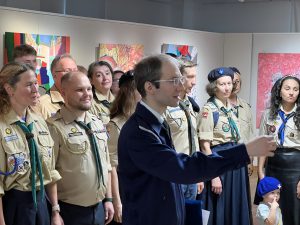
In this Exodus, Russian scouts also departed into exile, helping ship crews with signaling and assisting families of the military. Now it is heartening to see scouting revived, and we attended the 25th Jubilee of the Moscow troop “Krutitskoye Podvorye” of ОРЮР in the main hall of the House of the Russian Abroad, with a ceremonial formation and a grand concert program.
An Example of Noble Service
Another significant event at the House of the Russian Abroad was an evening in honor of the 75th Jubilee of Count Sergey Alekseyevich Kapnist. I. V. Domnin led the program, which, through numerous photographs, illuminated the history of a family that endured the horrors of the Civil War, its life in France, and the work of Sergey Alekseyevich, who devoted himself to serving God, the Motherland, and his fellow man.
His work with the historic Russian Red Cross in Russia and abroad, and his charitable activities — for which he even recently undertook unsafe journeys to places such as Mariupol — demonstrate a true example of nobility.
50 Films from Around the World
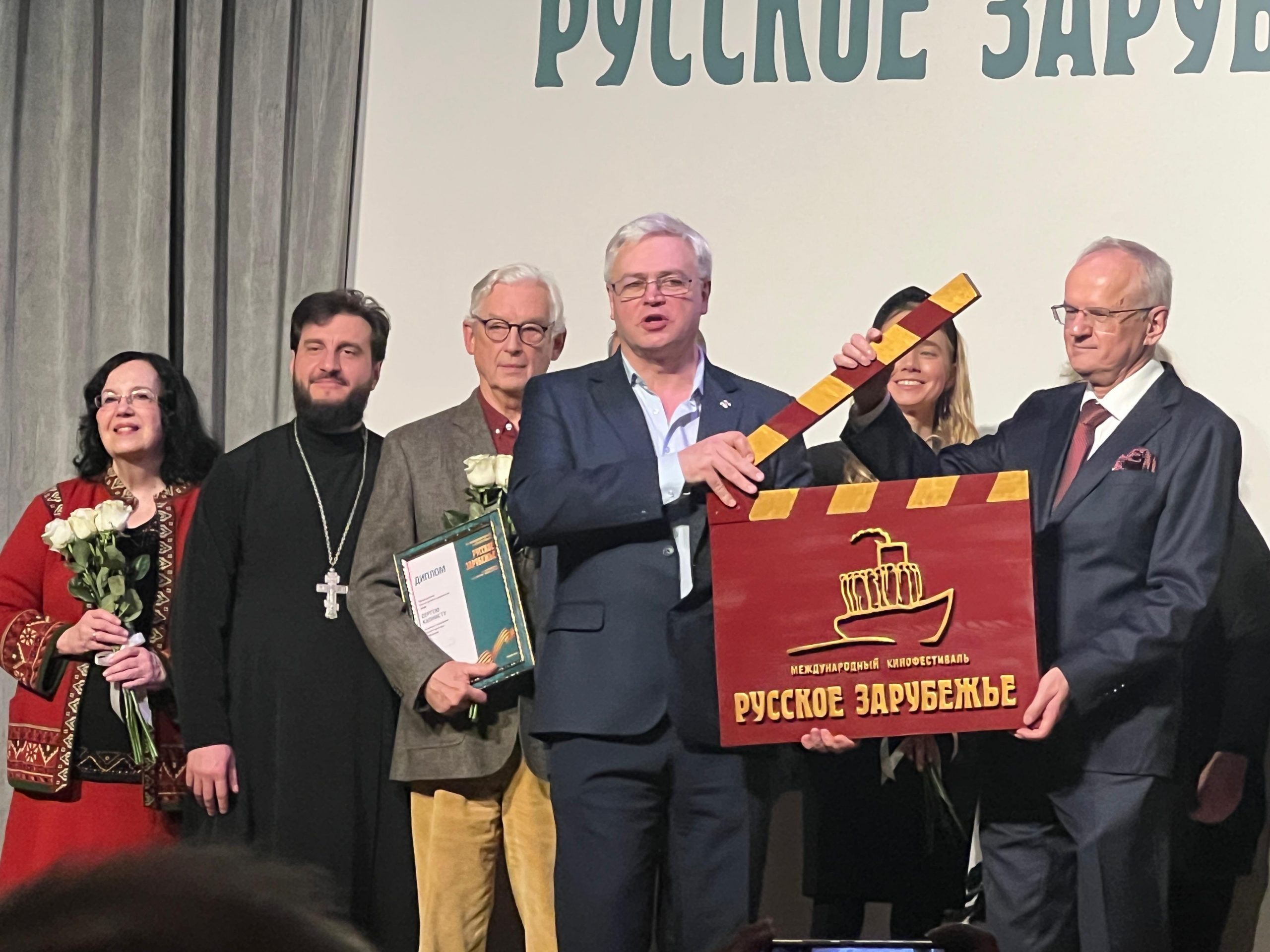
The concluding Jubilee event of the House of the Russian Abroad was the 19th International Film Festival “Russian Abroad”, to which my son and I were invited on its opening day, just before our departure. The program featured more than 50 feature films and documentaries from ten countries: Albania, Belarus, Bulgaria, Germany, Spain, Canada, Russia, Serbia, Uzbekistan, and France.
Several films were dedicated to jubilee anniversaries of figures in science, culture, and the Orthodox Church, whose destinies were closely tied to the Abroad: the 160th anniversary of the birth of Saint Tikhon, Patriarch of Moscow and All Russia; the 150th anniversary of the artist Mstislav Dobuzhinsky; the 120th anniversary of Nobel laureate Vasily Leontiev, and others.
I was spontaneously invited to say a few words at the opening ceremony. I said that cinema is one of the most powerful forms of art, and it was precisely Russian films I saw in childhood — such as Eisenstein’s Alexander Nevsky — that allowed me, a child of the third generation abroad, to feel my Russian soul. And the films shown by the House of the Russian Abroad reveal the truth about Russia, which must be known in order to restore her to all her former greatness. As Saint Grand Prince Alexander Nevsky said: “God is not in might, but in Truth!”
Leave a Reply
You must be logged in to post a comment.