
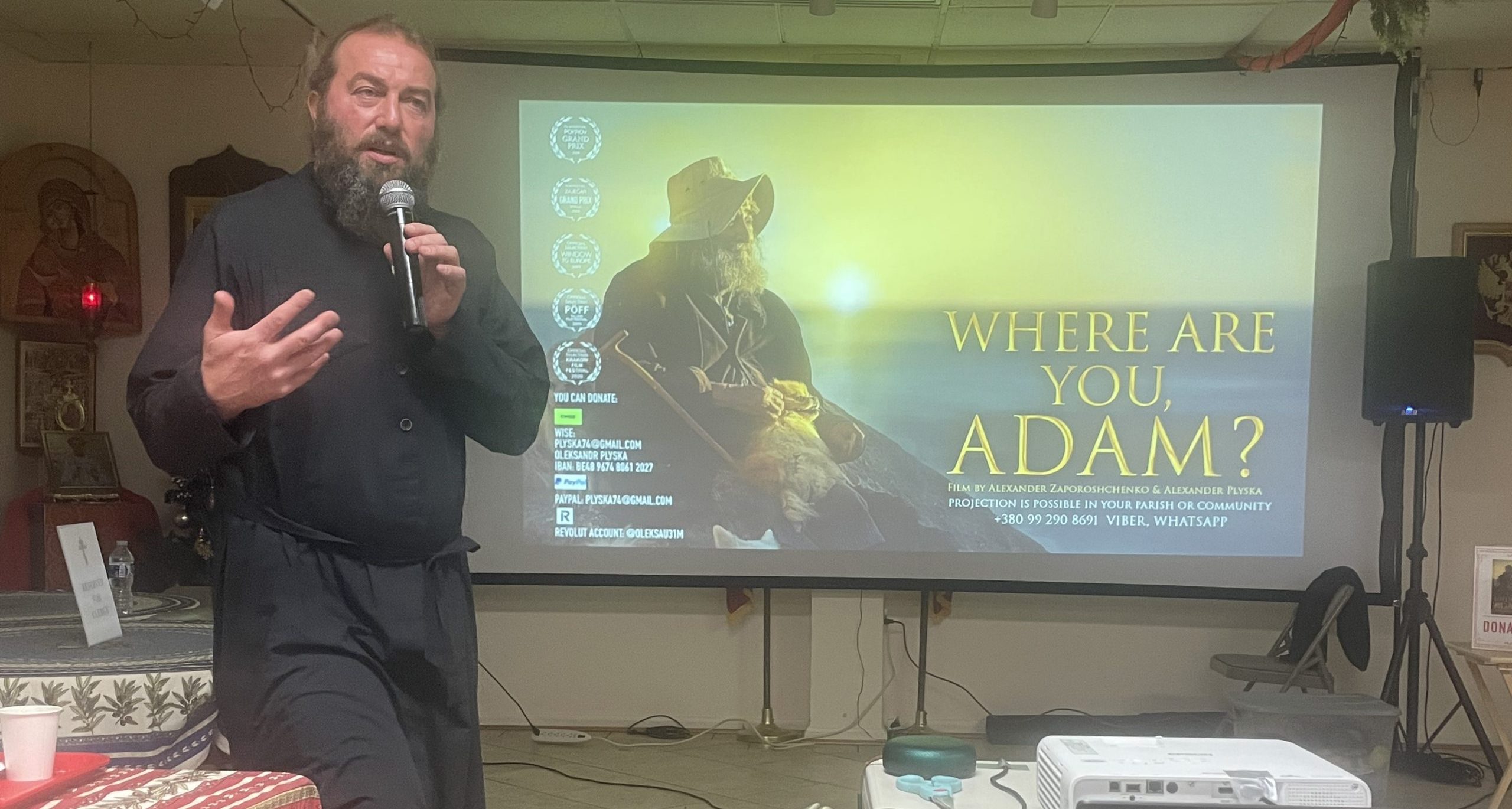
In 2019, the documentary film “Where Are You, Adam?” was released in Ukraine, offering a rare look into the Greek monastery of Dochiariou on Mount Athos. The film was shot by cinematographer and director Alexander Zaporoshchenko and produced by Protodeacon Alexander Pliska. That same year, it won the Grand Prix at the “Pokrov” Christian Film Festival in Kiev and was subsequently screened in Krakow and Tallinn. In 2020, it became the first Christian documentary to receive a national theatrical release in Russia, while in Israel, it was shown in the country’s most prestigious cinemas. The film has already traveled to Greece, Bulgaria, Macedonia, Serbia, Georgia, and other nations. Late last year, screenings were organized for the first time in the United States, where audiences in Boston and Miami have already seen the film. This January, it was viewed in Hawaii and Los Angeles; in February, it heads to San Francisco and Sacramento.
During a meeting with parishioners of the St. John the Baptist Cathedral (ROCOR) in Washington, D.C., producer Protodeacon Alexander Pliska shared that the film began with the personal spiritual rebirth of the creators, who first arrived at the Dochiariou monastery as pilgrims many years ago. Ten years passed before the monastery’s abbot, the late Archimandrite Gregory, gave his blessing for the filming. Initially, he told the guests rather sternly: “Enough talking; stay, live with us, work, and we shall see what you are worth…”
The title of the documentary refers to the biblical narrative where God asks the first man, who has sinned and hidden himself: “Where are you, Adam?” However, the film can hardly be called a missionary sermon. Its creators consider it, first and foremost, a historical document.
Cinematographer and director Alexander Zaporoshchenko intentionally avoided “pretty” shots during the editing process, despite having 80 hours of raw footage.
“We had several arguments over this, but my friend eventually convinced me that a ‘glossy’ aesthetic would not correspond to historical truth,” recalls Protodeacon Alexander.
Both Alexanders lived in the monastery for many months each year. Over time, the inhabitants grew so accustomed to the camera that they stopped noticing it. The lens “stood through,” so to speak, long night vigils in the church; it was present during the tonsure of a novice who had lived on Athos for eight years; it went out on motorboats for fishing, toiled in the kitchen, and worked under the scorching sun at construction sites. Once, it even became an involuntary witness to a quarrel and a physical fight between monks… In short, it captured monastic life without embellishment—full of labor, prayer, and, alas, the inevitable human passions and temptations.
The film has no voiceover, no staged scenes, no long sermons, and no strict chronological sequence. Instead, there is a sense of participation in a life strikingly different from our worldly existence. “Monasticism is not ‘normal’—it is above the norm,” shares Protodeacon Alexander.
“Many people I spoke with in the monastery didn’t know or think they would become monks. This state arrives like first love. You remember your first love, when your thoughts are only of her… similarly, monks think of God and want to let go of everything superfluous.”
One particularly striking scene is a long shot at the beginning of the film: a sick, paralyzed shepherd dog whines but still crawls after its master—the abbot—who is himself old and frail, supported by two assistants. This is perhaps the most piercing shot, which the cinematographer captured by chance but intentionally kept. It forces one to reflect on the “carrying of the cross” and on loyalty despite all odds.
Archimandrite Gregory himself admits in the film that he often regretted agreeing to become an abbot. But the brotherhood asked him, and he could not refuse. Perhaps this is the true burden of power: when a person carries it contrary to their personal desire for a quiet life. According to Protodeacon Alexander, Abbot Gregory instructed the brothers not to announce his death to other monasteries, but to bury him the following morning—quietly, prayerfully, and in a Christian manner.
Dochiariou is one of the 20 monasteries on Mount Athos that form the ancient monastic republic. Founded in the 10th century, it is located on the southwestern coast of the Athos peninsula. Empires rose and fell, and conquerors passed through this land with fire and sword, yet the monastery stands as a fortress of the spirit. Today, approximately 50 monks live there.
The authors emphasize that they did not try to “advertise” the monastery or “propagate” monasticism. They describe the documentary as a record of life—an attempt to show, as much as cinema allows, how monks live on this edge of the earth. “I would like our film to be watched primarily by non-churchgoers—those far from faith, living ordinary lives, who have never known how people live in a monastery,” says Protodeacon Alexander.
The authors already had such an experience in a Balkan country where a planned screening fell through. The producer asked the mayor’s office to invite any local residents: doctors, police officers, firefighters. Two Muslim clerics and a rabbi even attended. These people turned out to be the most attentive and grateful viewers.
Nevertheless, the film also leaves an indelible impression on believers. Protodeacon Alexander recalls that in various countries, elderly priests in their eighties would approach him and confess:
“After watching this film, perhaps it is no longer scary to die…”
Editor’s Note: The film is currently continuing its journey across the United States. To organize a screening, you may contact Protodeacon Alexander Pliska via WhatsApp: +380 99 290 8691.
Leave a Reply
You must be logged in to post a comment.