
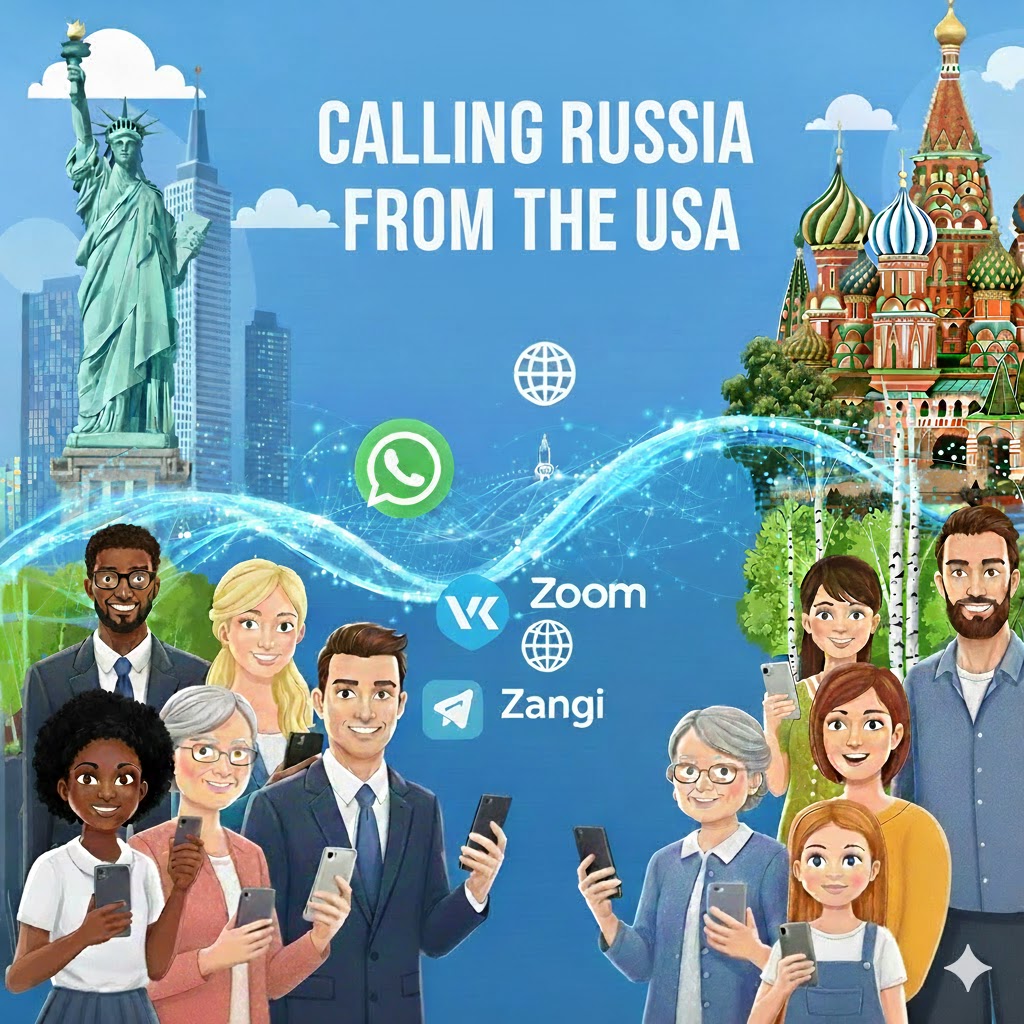
The most important communications link between the United States and Russia, free voice calls via messaging apps, has begun to fail. Following measures announced in Russia in August, voice calls on WhatsApp and Telegram have become unreliable. Text messaging and file sharing generally continue to function, but voice calls often fail to connect or drop mid-conversation. Russian regulators say the restrictions are part of an effort to combat fraud and enforce legal compliance by foreign platforms. The companies themselves argue that the measures amount to pressure on encrypted communications.
For Russians living in the United States who rely on daily contact with family back home, the result is the same: conversations now happen when the connection allows, rather than when they are needed.
According to the Russian regulator, foreign messaging platforms have become the primary tools used for scam calls and financial extortion, and limiting voice features is intended to reduce the effectiveness of such schemes.
As of this summer, WhatsApp remained Russia’s most widely used messaging app, with an estimated 95–97 million users. Telegram followed closely, with an audience of 89–91 million, according to Mediascope. For many families and businesses, these platforms had effectively replaced traditional phone lines for cross-border communication, making unreliable voice calls especially disruptive.
Restrictions have expanded steadily in recent years. Access to Viber was officially limited in December 2024. Signal was blocked in August of the same year, and Discord faced restrictions in the fall. Earlier, Russian courts banned Facebook and Instagram, designating their parent company, Meta, as an extremist organization.
In October 2025, a deputy head of Roskomnadzor said that during the first month after the new measures were introduced, fraudulent calls made through messaging apps declined by roughly 40 percent. Officials cite this figure as a key justification for maintaining the restrictions and explain why there has been no rollback.
In practical terms, the impact is felt daily. A routine morning call from the U.S. to Moscow often turns into multiple failed attempts: an app freezes, a message arrives promising a callback later, and by evening, the video connection becomes unstable. Families are forced to fall back on traditional phone calls, which lack features such as screen sharing and the sense of presence that video provides, particularly important when speaking with elderly relatives.
For entrepreneurs and managers leading cross-border teams, the problems are similar. Approvals take longer, deadlines depend on narrow technical windows, and internal procedures increasingly include contingency plans, from pre-generated video links to mandatory written summaries of decisions.
To restore predictability, families and businesses are adopting a two-channel approach. The messenger remains the first option, but not the only one. If a call fails to connect within a minute or the quality is poor, both sides switch immediately to a backup—either a standard phone call using Wi-Fi Calling on the U.S. side or a pre-established video room on platforms such as Google Meet or Zoom.
Russia’s newly promoted “national” messenger, MAX, offers little help to users abroad. Although it has been actively pushed and preinstalled in Russia since September, it is largely inaccessible in the United States. The app does not appear in Apple’s App Store, and while it is listed on Google Play, installation depends on the account’s country; users with U.S. profiles frequently see a notice stating that the app is unavailable in their region.
As a result, communication between the U.S. and Russia now depends less on any single app and more on users’ willingness to adapt. Flexibility has become essential to maintaining reliable family contact and business operations amid shifting platform rules.
Several alternatives remain fully functional in Russia. VK Messenger, developed by VKontakte, offers text and voice messaging, audio and video calls, group chats, and file transfers of up to 2 GB, and is available on iOS, Android, Windows, macOS, and Linux.
Zangi markets itself as a secure messaging alternative designed to work with minimal data usage, even on poor connections. Its developers say the app can operate under restrictions using anti-blocking technology. Zangi is available on iOS and Android.
LINE, a cross-platform messaging service, also continues to function without limitations. It supports text and voice messaging as well as free audio and video calls and is available on iOS, Android, and Windows, with automatic chat synchronization.
At present, none of these services face functional restrictions in Russia, making them viable alternatives to platforms whose voice features have been partially limited.
Leave a Reply
You must be logged in to post a comment.