
May marked the 80th anniversary of the Allied victory over Nazi Germany—a turning point in world history that brought an end to the bloodiest war in Europe. Yet in the United States, the date passed with little notice, despite an official proclamation from President Donald Trump declaring May 8 as “Victory Day” in World War II.
“After nearly 4 years of the darkest and bloodiest chapters ever recorded in human history, more than 250,000 Americans lost their lives in the fight against the Nazi regime.” Trump’s statement reads. “Without the sacrifice of our American soldiers, this war would not have been won, and our world today would look drastically different.”
— Source: The White House
Despite the proclamation, the 80th anniversary was scarcely marked in the U.S.: public events were few, and national media attention was minimal.
USA Today published a photo feature marking the 80th anniversary of Victory in Europe Day (V-E Day), showcasing striking archival images of spontaneous celebrations that broke out in cities like London, Paris, and New York when news of Nazi Germany’s surrender reached the public on May 8, 1945.
Source: USA Today
I found only a handful of additional mentions in the national press. This muted response raises questions about the place World War II memory holds in American society today, especially as the last surviving veterans pass away and the war itself fades from the forefront of historical awareness.
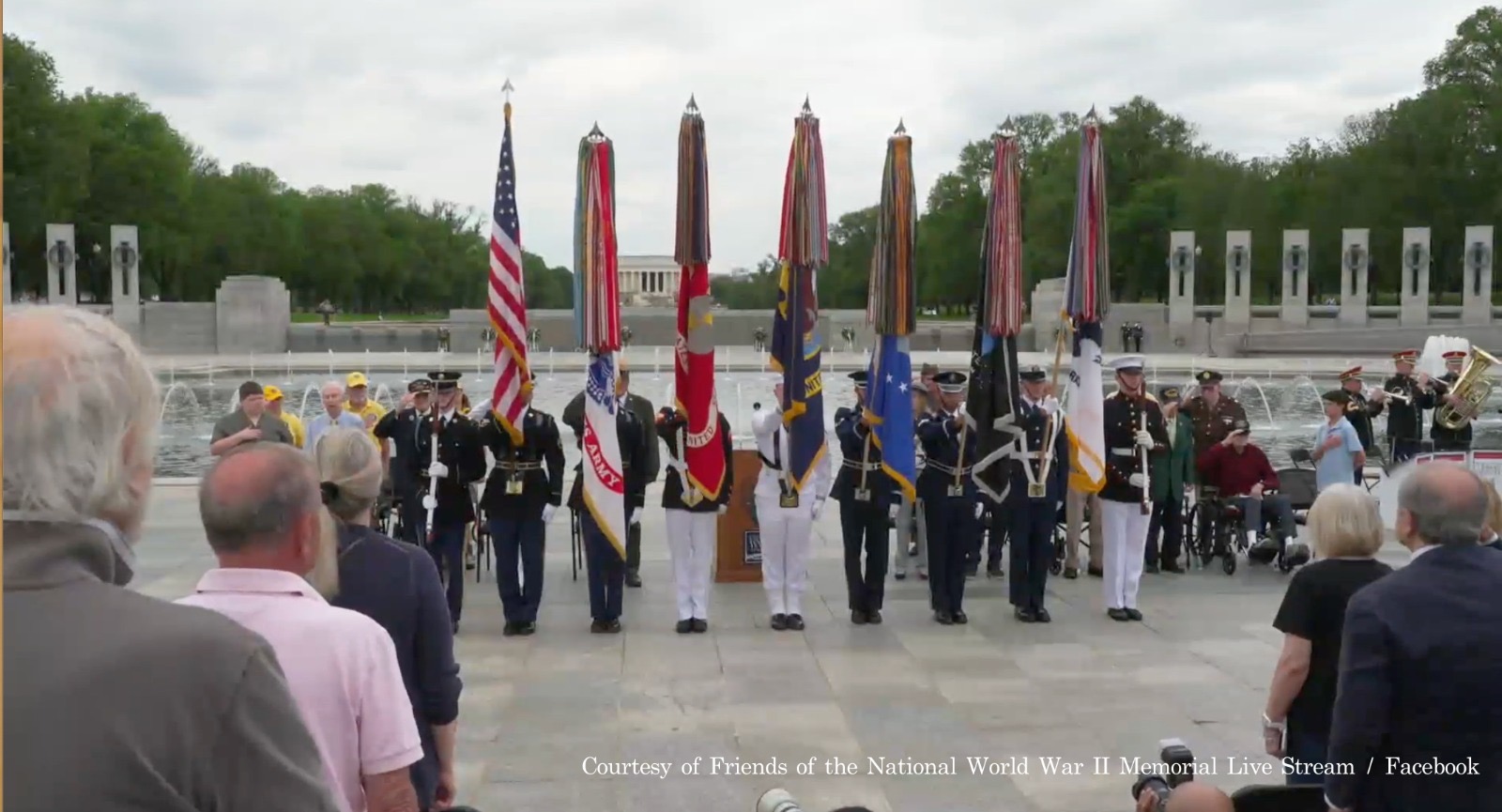
This year, only a few hundred people, including five WWII veterans who fought against Hitler, gathered at the National World War II Memorial in Washington, D.C., to mark the fall of the Third Reich. The modest scale of the event stood in stark contrast to elaborate celebrations in Europe, especially the grand military parade in Moscow’s Red Square. Foreign embassies were excluded from the Washington ceremony after a group of European diplomatic missions protested the inclusion of ambassadors from Russia and Belarus—two former Soviet nations that sacrificed millions of lives to liberate the world from the Nazi plague, according to Politico.
Source: Politico
Such a quiet approach to Victory Day is not entirely surprising. The first national World War II memorial in the United States wasn’t dedicated until May 29, 2004—nearly six decades after the war’s end.
“We don’t celebrate anything anymore—because we no longer have leaders who know how to do it! But we will start celebrating our victories again!”
— Trump on social media
It took 14 U.S. presidents after World War II for May 8—the date of Nazi Germany’s surrender in 1945—to be officially recognized as Victory in Europe Day (V-E Day). Due to the time difference, the Soviet Union and later Russia observed it on May 9.
Although the United States played a decisive role on the Western Front, the bulk of the war’s burden was borne by the Soviet Union, which fought the majority of Hitler’s forces and suffered staggering losses. After the attack on Pearl Harbor, the U.S. entered the war in December 1941, launching major operations in North Africa (1942), Italy (1943), and the famous Normandy landings (D-Day) on June 6, 1944. American forces engaged approximately 60 German divisions and suffered over 552,000 casualties, including 104,000 killed. The deadliest battle for the U.S. was the Battle of the Bulge, which claimed 19,000 American lives.
In an interview with NPR, 96-year-old World War II veteran Harry Miller recounted his experiences in the Battle of the Bulge. In late December 1944, near the town of Stoumont, Belgium, American soldiers from the 740th Tank Battalion hastily assembled several M4 Sherman tanks and one M36 tank destroyer. Within the first half hour of combat, they managed to stop three tanks from the elite German 1st SS Panzer Division.
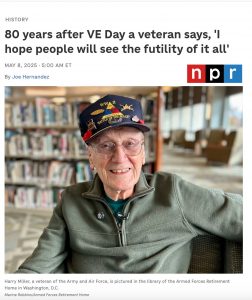
“The word got out that we were a tough little outfit because in our first half hour of combat we stopped the 1st SS Panzer, which was quite a deal, so we became quite famous all of the sudden” Miller told NPR, adding, “I was more amazed than anything because, knowing the condition those tanks were that we put together, it was bad.” Later, the battalion broke through the fortified Siegfried Line and, on May 2, 1945, liberated the barbed-wire fences of the Wöbbelin concentration camp, a subcamp of Neuengamme. Reflecting on his service, Miller said:“I was 15 when I went in, 16 in the Bulge. War ended. Two months later, I was 17. And I’ve never regretted a day of it.”
Source: NPR
As for the Soviet Union, the Encyclopaedia Britannica estimates that over one million Soviet soldiers died in the Battle of Stalingrad alone—fifty times more than U.S. losses in the Ardennes. German and Axis losses at Stalingrad exceeded 800,000.
In total, the USSR lost between 26 and 27 million people, including about 11 million military personnel and over 15 million civilians, in fighting against more than 200 divisions of the Wehrmacht. One of the most horrific episodes was the Siege of Leningrad, which lasted from September 1941 to January 1944 and resulted in the deaths of more than 1.5 million civilians from starvation, cold, and bombing.
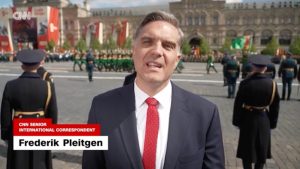
On May 9, 2025, Russia marked the 80th anniversary of its victory over Nazi Germany with a massive military parade on Red Square in Moscow—an event that received broad coverage from leading American media. According to CNN, over 11,000 troops participated, including foreign contingents from China, Belarus, and other nations. American coverage emphasized Russian military hardware on display: from historic T-34 tanks to modern S-400 air defense systems and Iskander-M missile launchers. For the first time, drones were also included, highlighting the changing nature of warfare. U.S. commentators also noted the attendance of over 20 foreign leaders, including China’s Xi Jinping and Brazil’s Luiz Inácio Lula da Silva. Similar parades were held in major Russian cities.
Unfortunately, much of the American media coverage overlooked the close wartime cooperation between the U.S. and the Soviet Union, despite ideological differences. Under the Lend-Lease program, Washington provided Moscow with over $11 billion in aid, including tanks, trucks, aircraft, food, and fuel. In return, the USSR also provided material support to the U.S. under reverse Lend-Lease.
In spring 1945, American and Soviet troops famously met at the Elbe River in Germany. These historic photos and newsreels are still widely used by the global press when recounting the triumph of the anti-Hitler coalition.
Leave a Reply
You must be logged in to post a comment.