
About Us
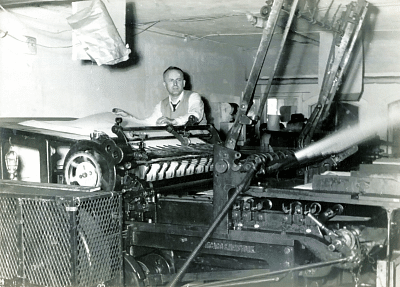
The First Linotype Operator Cheusov
In 1921, the first Russian weekly publication in San Francisco appeared under the name “Russkaya Zhizn” (Russian Life), with its own editorial office and printing press. It was published by an American named Clark. It is difficult to say how he, without knowing the Russian language and having no connection with the small Russian colony that existed at that time, became the publisher of the third oldest Russian newspaper in America.
The first was the church-social newspaper “Svet” (The Light), and the second — “Novoe Russkoe Slovo” (The New Russian Word) in New York. The idea to create a newspaper was proposed to Clark by a small group of Russians who had come to the United States, most of whom did not know English. Clark hired Georgy Grigorievich Grigoriev as the chief editor. After operating successfully for 16 years with the same staff, the newspaper passed to a new owner.
On March 4, 1937, Pyotr Petrovich Balakshin bought Russkaya Zhizn from Clark and renamed it “Russkie Novosti-Zhizn” (Russian News-Life). “In the many-thousand Russian colony of San Francisco and the neighboring bay cities,” Balakshin wrote in his first editorial article, “there has long been a need for some practical and economical means of communication. Russian industrialists, businessmen, merchants, public figures, pastors, agents, lecturers, actors, and singers all need such a means of communication.”
Balakshin involved many well-known journalists from California in the newspaper. The experienced journalist Nadezhda Lavrova (Shapiro) published articles titled “What They Talk About” — covering Russian education in America, the Art Theater Society, the Society of Russian Doctors, the Officers’ Club of the Russian Imperial Navy, and other Russian organizations in San Francisco.
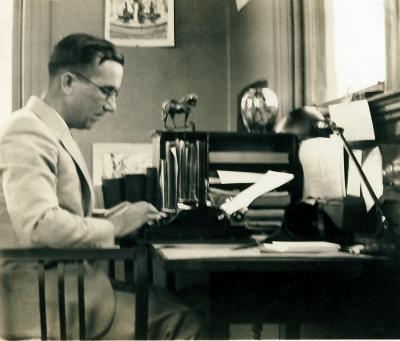
Balakshin at the Press
One of the best Russian journalists in San Francisco was Tamara Bazhenova, who regularly published original interviews and historical essays — for example, about the historical Russian fortress in California, Fort Ross. For some time, she lived in Los Angeles, conducting interesting interviews and reports from Hollywood film sets.
The newspaper actively participated in organizing charitable events in the city. “Russkie Novosti-Zhizn,” wrote P.P. Balakshin, “invites the Russian community in San Francisco to come to the aid of Russian Shanghai. For this purpose, we are opening a donation fund, which will be transferred to the United Committee of the R.N.O. or to a specially created committee. Russkaya Zhizn will provide free advertising for all possible events, concerts, and gatherings organized to benefit Russian Shanghai.”
From November 19, 1937, the newspaper began publishing in an enlarged format. The reason was Balakshin’s desire to make the paper more literary and profitable.
He announced that the best Russian literary figures of the emigration would participate: M. Osorgin, M. Aldanov, N. Teffi, I. Bunin, poet A. Nesmelov, M. Shcherbakov, and others. “While placing the social, national, and personal interests of Russians at the heart of the newspaper,” one article stated, “the editorial office nonetheless must take steps to strengthen its financial position and therefore humbly asks all who appreciate the privilege of having THEIR OWN NEWSPAPER in San Francisco to support it morally and financially.”
One of Balakshin’s distinguishing traits from other Russian editors-publishers was that he was not afraid to publish opinions he disagreed with, trying to avoid polemics. This was especially important in the early days of the war between Germany and Russia. According to his vision, the newspaper was meant to unite the emigration. He emphasized that “the newspaper has always moved toward Russian social life; being an inseparable part of it, it has warmly responded to all its needs, provided pages to support various fruitful ideas, and always maintained a decent, balanced course. It has always been benevolent toward different Russian organizations and individual members of our colony.”
Publishing a Russian newspaper was very difficult. Balakshin wrote:
“It’s easier to find an editor with good newspaper experience than a good linotype operator. In the Russian press, the dead weight of employees from the Shchedrin era still drags it down with their rigidity. Unfair reproaches and demands are often made of the Russian press and its editors. There’s still a nasty habit among provincial people — to ‘expose’ someone in public for a minor mistake, to demand a public trial, etc.”
Unfortunately, financial difficulties forced the publisher to consider selling the newspaper. This happened at the end of 1941.
By the initiative of Major General A.N. Vagin, the newspaper was purchased by the Russian Center Corporation. This occurred on December 20, 1941, when the newspaper came under the administration of the Russian Center in San Francisco and became a daily. The chairman of the center, A.N. Vagin, declared that “Russkaya Zhizn will be an impartial public organ, supporting the good Russian name and every honest and useful Russian endeavor, both public and private.” Since then and to this day, the newspaper has been located in the building of the Russian Center.
An interesting and prominent editor from 1942 to 1944 was Georgy Konstantinovich Gins, who, during the Civil War, had served as a member of the Council of Ministers under Admiral Kolchak, the Supreme Ruler of Russia. He was very active in the socio-political life of the Russian diaspora in San Francisco and taught Russian cultural history and Soviet law at the Monterey Institute of Foreign Studies.
During the war, the newspaper organized charity events to help suffering compatriots in their homeland.
“Russkaya Zhizn” covered events in the lives of the Russian diaspora not only in the United States but also in other countries of Europe and Asia — including Shanghai, where a large Russian community existed until 1949.
With the beginning of the Cold War, the Russian periodical press fought against Russophobia. Its pages regularly featured articles defending the Russian nation and culture. For example, one Saturday issue of Russkaya Zhizn (October 8, 1983) was printed in Russian and English in 1,000 copies and distributed free of charge among senators, congressmen, and governors of all U.S. states.
The story of the newspaper does not end there — today it continues to unite the descendants of the first wave and representatives of the fourth.
The mission of the newspaper’s editorial office today is to continue informing readers about the events of the Russian diaspora’s public life, to serve as a chronicle of the Russian community, to remind readers of important anniversaries of national history, and to explain modern Russian realities to the descendants of emigrants.
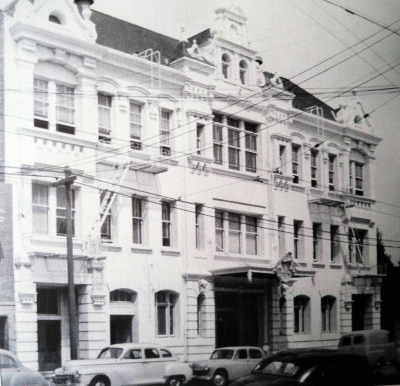
The Russian Center in San Francisco
Russian Life Inc. is a registered nonprofit organization dedicated to serving the Russian-speaking community in the San Francisco Bay Area and beyond. Officially incorporated under U.S. law, we operate as a tax-exempt public charity under section 501(c)(3) of the Internal Revenue Code (EIN: 94-0822792).
Our headquarters are located at 2460 Sutter Street, San Francisco, CA 94115, and we are licensed to carry out our mission of publishing a volunteer-based monthly newspaper that provides current events, historical, cultural, and educational content. Guided by our commitment to education and community service, we continue to be a trusted source of information and connection for residents with limited access to other media outlets. For more information, please visit our official website: russianlife.online.